Strength and muscle size do not correlate. Here are the factors that determine your strength:
I. Fast twitch muscle fibers
These are the muscle fibers that are really strong but can only fire for up to five seconds.
II. Slow twitch muscle fibers
These are the ones that are used first when you actively move. Your body prevents you from using all your muscles and strength at once because it could literally break your bones. Through strength training, you learn to unlock more of your potential power by recruiting these fibers more effectively.
III. Muscle density
Your muscle density can grow by decreasing intramuscular fat or through hyperplasia. However, hyperplasia (increasing the number of muscle fibers) is more likely only during puberty or when using steroids.
IV. Muscle control
Your ability to orchestrate your muscles while moving is called muscle control. If you, for example, flex your biceps while punching, you are preventing your full force output. It isn’t just important to use most of your muscles, but to use the right muscles in the right way.
V. Circulation
Factors like smoking or cardio training can decrease or increase your circulation and, therefore, your maximum force output. Cardio training, in particular, triggers adaptations such as the formation of new blood vessels to support your muscles with nutrients and oxygen.
VI. Flexibility
Using and training your muscles in the full range of motion can decrease your force output in the short term, but this approach increases your long-term strength gains significantly. Note that hyper-flexibility is a common phenomenon, but it can actually affect your strength negatively.
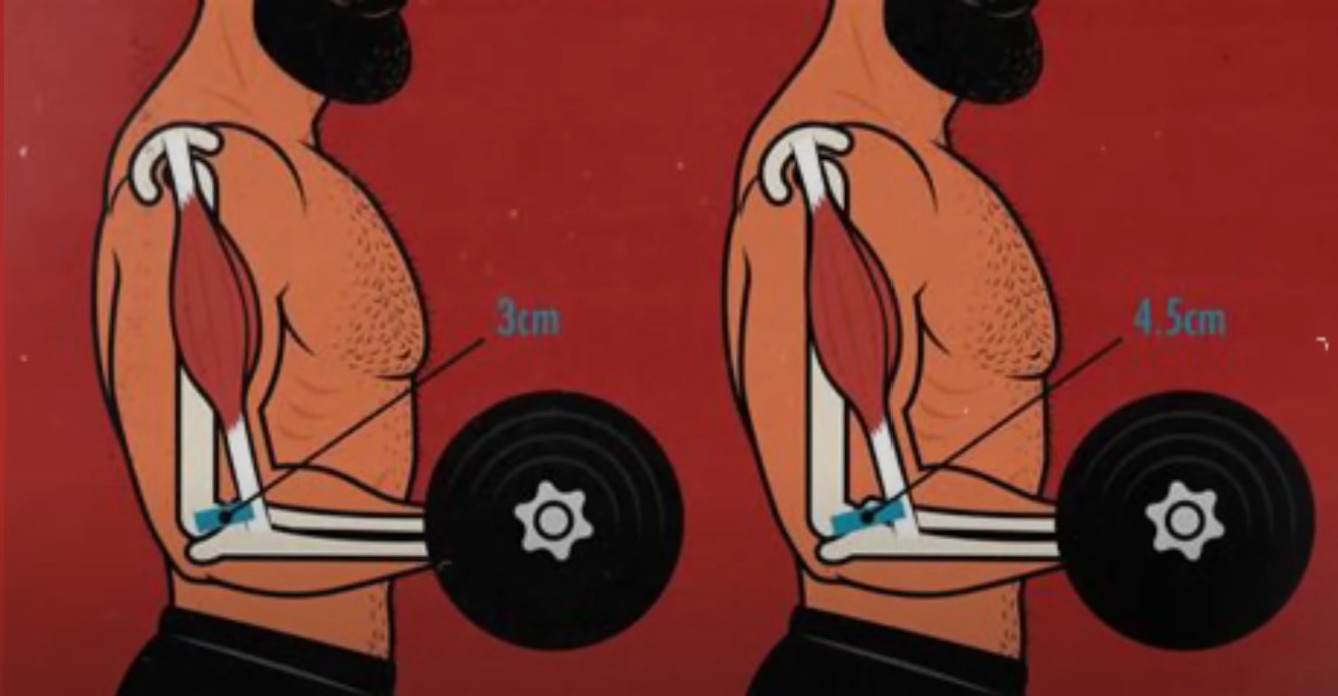
VII. Insertions
Your muscle insertions are a hidden factor that can highly impact your force output. Moving the point where your muscle is bound by just a few centimeters can double the weight you can lift due to mechanical advantage.
- Calves: People with low calves have more room to put on muscle, while people with high calves can run faster and jump higher because the extended tendon acts as a spring.
- Ab muscles: Some people have a ten-pack instead of a six-pack due to their insertions. Arnold Schwarzenegger is a famous example of someone with only a four-pack.
VIII. Connective Tissue
The fascia tissue connects your whole body and holds it together. A recent article showed that it can actively move and therefore influence musculoskeletal dynamics. Your fascia grows with mechanical tension; you can increase fascia mass by lifting heavy weights with low repetitions.
IX. Weight (dead weight)
If you perform a kick with your leg, but your leg has twice the weight, it will have a much higher impulse. Being heavier makes it easier to transfer your momentum onto a weight or a target. Imagine two huge cannons: one made of steel and one made of wood. The steel cannon won’t really move when shooting, while the wooden cannon will fly 15m in the opposite direction.